


Like A Dog Scenting A Lamp Post...
Posted by Jeremy Windsor on Mar 11, 2024

Helicopters play a vital part in mountain rescue. But it hasn’t always been the case. In this extract from Hamish MacInnes' “Mountain Disasters” the author recounts the early days of their use…
I first met helicopter pilots Markus Burkard and Günther Amann in September 1973 when Dougal Haston and I were landed by winch wire at the Eiger's Death Bivouac. That lower, Dougal's first, must have been quite an initiation. Being in the rescue business, I had done many previous lowers, often in bad conditions, so it wasn't quite so alarming for me, but to be whisked up from that awesome face on a slender steel wire, out over the verdant pastures of Alpiglen, gives one pause for reflection with 7,000 feet of space beneath your crampons! It was Günther who was piloting on that occasion and it wasn't until the following year that I flew with Markus. Whereas Günther is inclined to be introspective and quiet, Markus is more carefree, though no less careful than his colleague.
These two pilots have saved many climbers and skiers in difficulties in the Swiss Alps.
The insurance service provided by the Swiss Mountain Rescue Flight provides an excellent service. Its pilots, like their compatriots doing the same job in Chamonix, have proved beyond doubt that mountain rescue with helicopters is by far the most efficient means of taking the injured off mountains.
Helicopter winch rescue originated in Britain where it was developed for Air-Sea Rescue. It was first used in the Alps in 1961 on the East Face of the Watzmann, a peak near Berchtesgaden. The aircraft used was an old Sikorsky. Though many different types of helicopters are in use for rescue work today, the French Alouette has been the most popular workhorse and its souped up small brother, the Lama, is one of the few helcopters which can lift its own weight; it also holds the world altitude record of almost 41,000 feet. Now there are many new high powered kids on the block, such as the BK117, and some of these also give good high-altitude performance.
The Eiger North Face didn't succumb easily to this helicopter revolution. Here, too, as with other firsts, psychological barriers had to be broken and it wasn't until 1970 that Günther, as a rescue exercise, lowered Rudolf Kaufmann, a Grindelwald guide, on to various parts of the face, the Spider, the Flatiron and the Ramp.
This was an amazing breakthrough, but prior to this the helicopters had played a combined operations role. For instance, a rescue team was flown to the summit ridge in the winter of 1970 with winching equipment and an injured Japanese climber was taken up from the Exit Cracks. Fixed belays were established at the top of the mountain, at the finish of the Ramp and the North Pillar, which meant that in the event of a rescue taking place in weather too severe for a helicopter to operate, normal winching procedure, as pioneered by Ludwig Gramminger and Erich Friedli, could be swung into action with the minimum of delay.
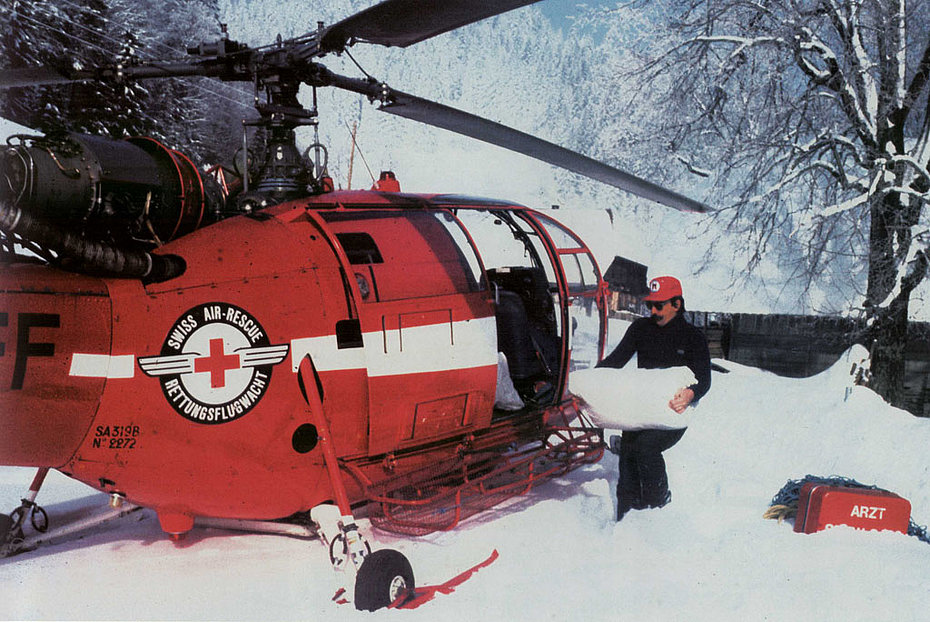
Markus Burkhard working for the Swiss Air Rescue Guard alongside his Alouette 3 helicopter
During the summer of 1970 that astute master of the telescope, the late Fritz von Almen saw from his base at Kleine Scheidegg that one of two Italian climbers had fallen, close to where the unfortunate Corti had bivouacked many years before. He informed the authorities and at dawn next day a rescue party was flown to the summit ridge and a guide lowered by winch wire to the scene of the accident. Angelo Ursella, a climber from Udine, had fallen thirty metres and unluckily some coils of his rope had caught round his neck. He was immediately strangled. His friend, de Infanti, was whipped off his belay, but being uninjured, managed to climb back up to his stance. The guide got de Infanti to the summit shortly after midday. Ursella's body was recovered later.
In September of that same year, the first exclusive helicopter rescue was done on the face. Günther Amann was the pilot. The circumstances leading up to this rescue, which fortunately ended happily, were rather bizarre. Two German climbers, Martin Biock and Peter Siegert, started up the original route. They were both strong climbers. Siegert, for example, was one of the first to try the Eiger Direct in winter and was also a member of the party that made the first winter ascent of the Matterhorn North Face. However, the Eiger didn't seem congenial, for at the Difficult Crack Biock dropped the rucksack he was hauling up a pitch and, though they recovered it some 200 metres below, Siegert's crampons had been lost. One advantage of their close proximity to the 3.8 window was that it made commuting possible and Peter dashed down to the Stollenloch window, took a train to Grindewald, where he bought a new pair of crampons and was back on the climb with Martin by midday. By now the sun was causing havoc and the usual stone trundles had started down the Hinterstoisser I raverse, so they decided to get to the Second Icefield via the Japanese Route, up the Rote Fluh. This is the intimidating overhanging red wall to the right of the Hinterstoisser. It was whilst bivouacking in hammocks from this huge overhang that night that they discovered that their stove had been damaged in the fall and couldn't be used. For some reason best known to themselves, they decided to carry on next morning, but by the evening had only reached Death Bivouac. When they were at this fateful ledge the weather broke with a vengeance, typical of the Eiger, and the next two nights were spent at this isolated eyrie.
On the second night they signalled for help by torch and Kurt Schwendener, the rescue boss in Grindelwald, set the rescue machine in motion. The weather was still bad next day and in case Amann couldn't get in with the Lama, Schwendener also arranged for a group of guides to be ready at the Stollenloch. Despite intermittent cloud Amann got close enough to the bivouac to speak to the two Germans using the helicopter loud hailer, for he was not absolutely sure that they now wanted to be rescued. In the past many climbers had retreated from Death Bivouac and above, and it was assumed that these two were uninjured. Later, when the cloud cleared, Amann saw that they had abseiled two rope lengths to the side of the Flatiron and here they made definite signals that they wished to be picked up.
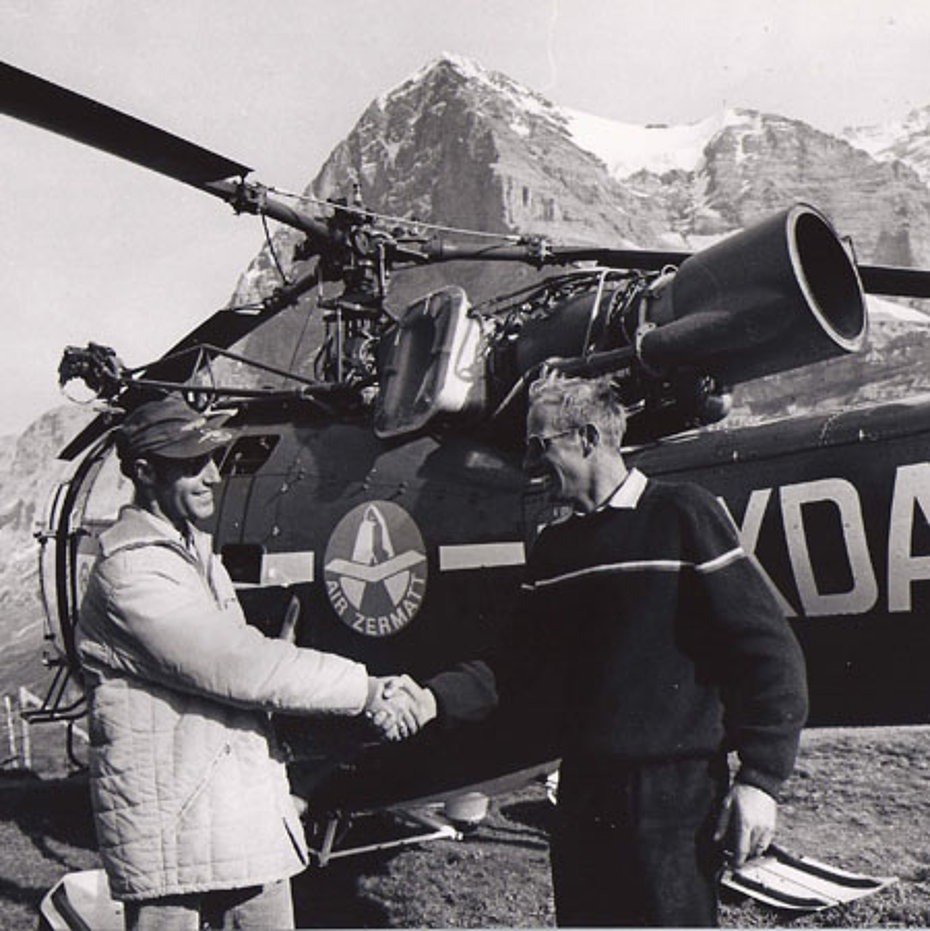
Gunther Amann (left) shaking hands with Rudolf Kaufmann (right) after their successful rescue of Martin Biock and Peter Siegert in September 1971
Rudolf Kaufmann, the guide, was lowered to the tiny stance (the size of a biscuit tin lid) and Biock was hoisted up and taken to Scheidegg. Fifteen minutes later both Siegert and Kaufmann were winched aboard in safety. In all, the rescue had taken less than an hour.
Between 1973 and 1977, I did many flights with Günther Amann and Markus Burkard connected with filming and TV. Most of the winch lowers were either on the North Face or on the West Flank. My last trip with Markus was a hurried one. I had a meeting in Zürich about a possible live TV climb of the face and I had to check on one or two points, which meant a flight to a ledge high on the West Flank on a cold September morning. I had only four hours to complete this work. The well known Swiss climber and guide, Hans Muller, was with me and when Markus dropped us off on a snow-covered ledge, it felt both lonely and cold.
The mountain was in the first grip of an early winter. The helicopter landed close to Kleine Scheidegg, keeping in radio contact with us for the return trip.
When our survey was completed we called Markus on the walkie-talkie and he picked us up. On the descent I asked him if he could fly close in to the Japanese Direct route to enable Hans to check on some ledges which we were wanting to see. Hans had done the route in both summer and winter. Markus nosed the Alouette into the wall like a dog scenting a lamppost, until we were below the great overhang above and to the right of the Rote Fluh. He then eased the helicopter beneath this so that the deafening roar of the rotors and the gas turbine bounced down on us from the rock roof. It was both exhilarating and frightening, yet he was in perfect control. His only apparent concern was before he took the machine beneath the rock when he asked Hans if the overhang was solid. Hans had assured him that it was. This is typical of the confidence which these pilots have in their crew, for both the winchman and the guide have to be experts also and equally cool in a crisis…
“Mountain Disasters” is part of the excellent “Mammoth Book Of…” series published by Constable and Livingstone. Second hand copies are widely available online and are highly recommended.
Thanks for reading this post. If this is your thing why don't you take a look at other posts on the blog? Better still, why not join the British Mountain Medicine Society? More information can be found here.
For more information about the University of Central Lancashire's Diploma in Mountain Medicine (DiMM) take a look at this.
Find out more about mountain medicine research at the UCLan Centre for Mountain Medicine.

Comments
Leave a comment.
Leave a comment.

 )
) Bronze
 Silver
 Gold
Gold Platinum
 Palladium
 Internal