


"I Can't Do Altitude Anymore..."
Posted by Jeremy Windsor on Nov 8, 2024

Atrial Fibrillation (AF) is the commonest cause of an irregular heart beat. Said like that, it sounds like little more than an inconvenience. Unfortunately that’s far from the case. As we saw in a previous post it can have a devastating effect upon someone’s health. In some cases it makes it almost impossible to live an active life and in the long term, significantly increases the risk of having a life threatening stroke. In this post I talk to Brett Abikhair who was forced to abandon his attempt on Lenin Peak (7134m) after his AF returned…
Thanks Brett for talking to me. Before we start can you share with us a little bit about your background?
I’m based in the Byron Bay region of Australia, which is on the country's East Coast - sub tropical climate. I'm 58, a Financial Adviser, and have done trips to Mt Meru and Mt Kilimanjaro in Tanzania, and a number of New Zealand trails and mountains, the main ones being the Rabbit and Gillespie Passes. Never had any climbing experience, and was excited to do the prep, both gear and fitness, to be ready for my tilt at Lenin Peak.
When did you first develop AF? What treatment did you receive?
Had "Severe and Uncontrolled Atrial Fibrillation" out of the blue, commencing in July 2020. By that Xmas I’d had 8 visits to the operating table, for a total of 6 cardioversions and 2 ablations. The last ablation seemed to fix the problem - I still occasionally had AF, but my heart was able to reset when it did, without intervention. By the time 2024 rolled round it had been a good 2 years since I’d had an incident.
Can you describe your preparations for Lenin Peak? What efforts did you go to in order to reduce the risk of AF being a problem?
I consulted with a Cardiologist, a GP and a Sports Medicine Doctor. They were all OK with what I was attempting, as was the Travel Insurance company I went through (they imposed a slight premium to the cost of the cover but were fine with covering me). I did a stress test, and of course was training sometimes 2+ hours a day, working on both my cardio and strength. There hadn't been any indication at all that altitude could trigger an episode, and no advice along those lines from any of the professionals I consulted with.
When I flew out of Australia for the trip I felt stronger than I had ever felt, and my cardio fitness was good.
On the flight over I watched "The 1996 Disaster - Storm over Everest", the PBS documentary that the movie "Everest" was based on - I made the decision after watching it, somewhere over the Indian Ocean, that I wouldn't under any circumstances, further endanger anyone else's life if I had a major episode with my heart - if there was a problem, I'd be bailing, if possible.
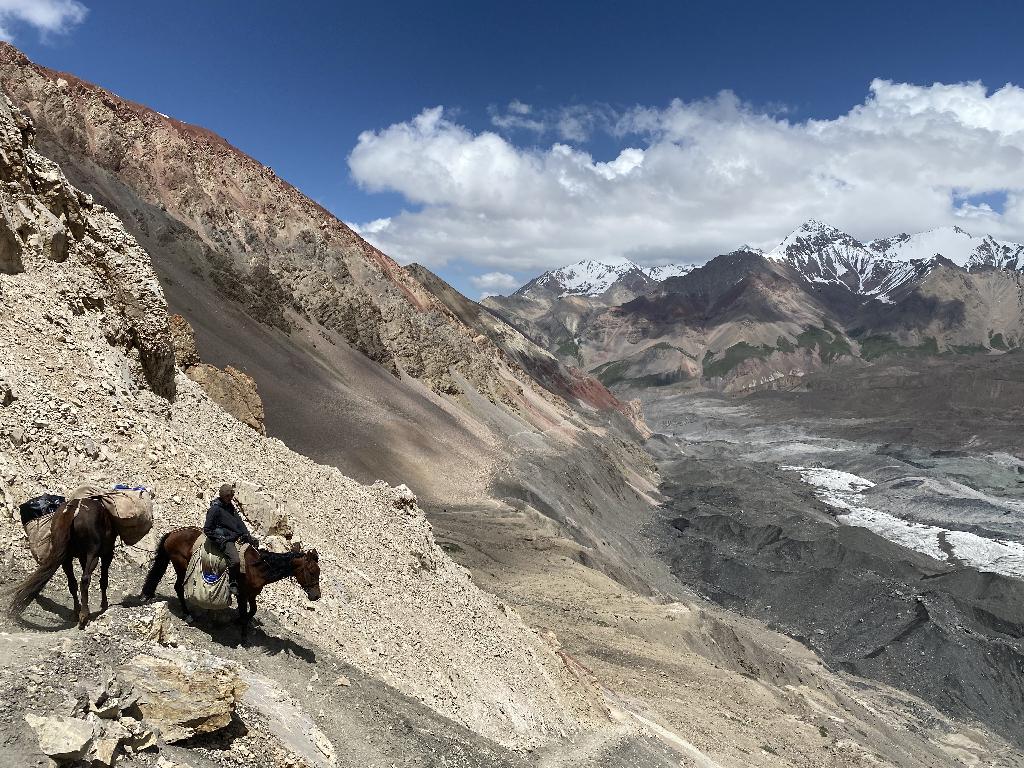
ABC/C1 is reached from BC on foot in 4-6 hours. Although not far, the 700m vertical height gain is a challenge
Can you talk us through what happened on Lenin Peak?
My group of 7 climbers and team leader were about 2/3rd of the way to ABC/Camp 1, heading up from Base Camp. I started to struggle for oxygen, but figured it was a bit of altitude, maybe some altitude sickness, and just pushed on. I started to really struggle with my breathing, then noticed I was gasping for air. I was falling behind my group by this stage, and one of the younger climbers was hanging back with me - he suggested I take 4 deep breaths, hold it and exhale. This worked - I had a rush of adrenaline, and could climb 50-100 metres, and then would stop, sucking hard for air, have a break, and do it over again. I still didn't think it was anything other than a bit of altitude sickness.
Then Tom, the young bloke hanging back with me, commented his heart rate was 143bpm - I looked at my watch, and it was 50. I knew straight away what that meant - my heart was in fibrillation, and my watch couldn't pick up a beat. No beat, no oxygen. At 4400m. I knew then I was done.
We called back the group, and I had a talk with the team leader. I explained what was going on, that I'd had the condition before, and although I'd been to 6000m before, it had been before the diagnosis back in 2020. I said I thought the altitude had brought on AF. We discussed medication - I said I had rivaroxaban (a blood thinner) in my pack, and we discussed what that would do - thinner blood = blood travelling quicker, but less capacity to carry oxygen. I had other medication, but it wouldn't "fix" the problem - it just helps manage it by trying to slow the heart - but it wouldn't put the heart back into rhythm.
He said to me, "Mate, if this happened tomorrow, or the day after, there’s a fair chance we might not be able to get you down off the mountain. What do you want to do?"
I remembered that movie. I remembered the promise I made to myself. I said I was out, could he help get me down the mountain?
We had a passing mule paid to take me to Camp 1, and during that afternoon and night, as well as most of the next day, I had trouble breathing - I simply couldn't get enough air into my lungs, and was constantly gasping. And that was sitting still in the meal tent. My heart was still vibrating, no regular beat. I said my goodbyes and by lunchtime next day I was back at BC, taken out by an amazing mule that carried my 110kg, plus his owner and 40kg of kit, over the mountain pass along a literal goat track. Was an adventure on its own!
Not long after, my heart went back into rhythm. It was in and out that day and next, but by the time I got back into Osh a day later it had pretty well settled down, though I'd occasionally catch my breath for the next 2 weeks - I think my heart was in and out of AF for that time, though mainly in rhythm.
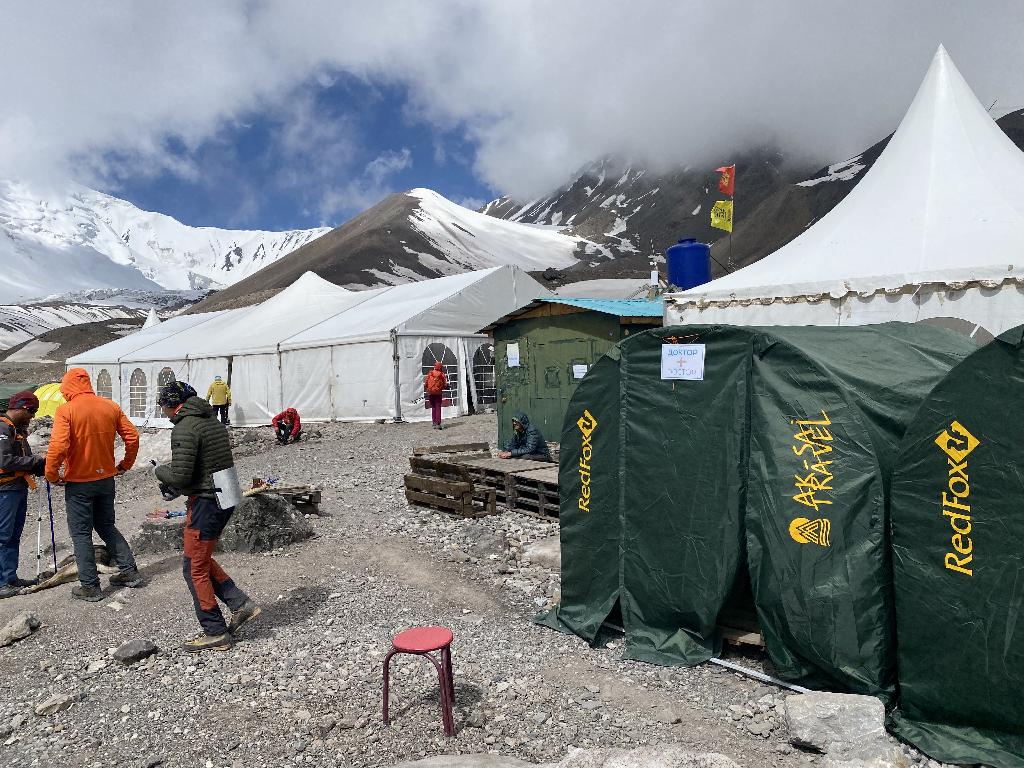
ABC/C1 is at 4300m. Whilst there are good facilities here, the altitude means that this is not the place to try and recover from a significant illness or injury
Where has this left you - in terms of your current health and your plans for the mountains in the future?
I was fully back to normal, and back into a solid training regime within 2 weeks of that AF attack. Ive had no repeats, and medical check ups have all been good.
Mentally I struggled a bit - after nearly a year of preparing, it had been a big let down, but I am a pragmatic person if nothing else, and at the end of the day the journey had been a great experience, from the moment I signed on to do the trip in mid 2023 - was a classic case of that saying, "its the journey that counts, not the destination".
I can't "do altitude" anymore - to be safe, nothing above 3000m I’d say. No medical guidance on that, just a ceiling I’ve set myself. Plenty of adventures to be had in this amazing world below that, and I have no doubt I'll be off adventuring again not too far down the track.
Thanks Brett! For more stories from Lenin Peak take a look at this. Information on volunteering on Lenin Peak can be found here.
The Slava Topol Project seeks to improve safety on Lenin Peak. To find out more and make a donation please click on this link.
If this is your sort of thing why not take a look at other posts on the blog?
Better still, why not join the British Mountain Medicine Society! More information can be found here.
For more on the University of Central Lancashire's Diploma in Mountain Medicine take a look at this.

Comments
Leave a comment.

 )
 Bronze
 Silver
 Gold
 Platinum
 Palladium
 Internal